
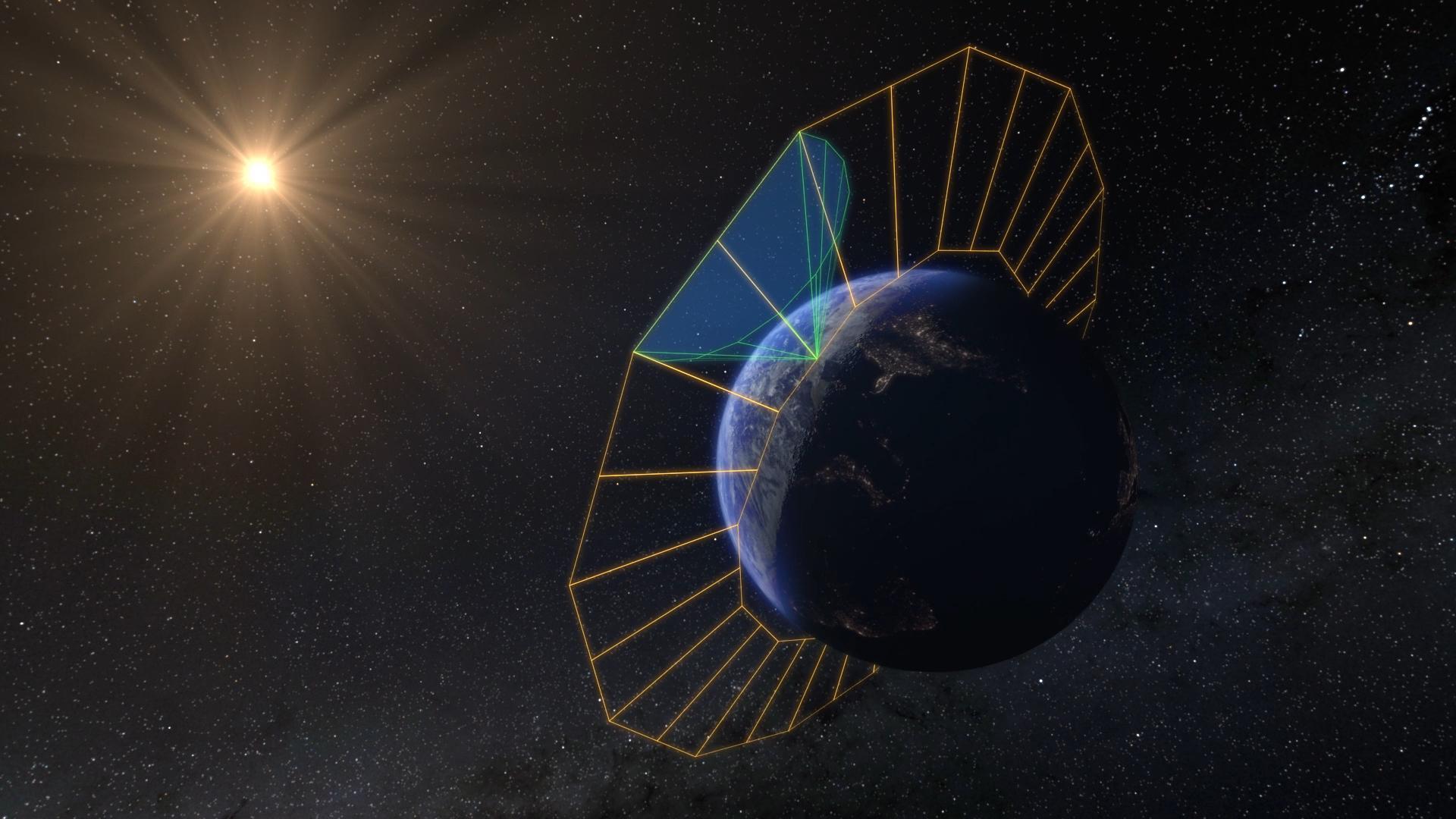
A New View of Our Starry Night, credit: Wendy Stenzel, via NASA Image and Video Library
This week in science, 13–19 October
Science news this week, 13–19 October 2026: NASA reported that its Roman Space Telescope beat expectations by nearly 30 per cent, Webb observations found three recurring atmospheric states on a brown dwarf about 20 light-years away, a fatty liver drug reversed disease only in animal models, and Antarctic sea ice reached its third-lowest winter maximum.
Most items are single studies, and several are early results. Each section below says how strong the evidence looks, and the tables list what was reported and when. For a general method, see how to evaluate a claim.
Space: a telescope beats expectations and a young planet candidate
NASA's Roman Space Telescope was reported to have exceeded expectations by nearly 30 per cent. Engineers moved a mirror by a distance described as one-sixteenth the width of a human hair to sharpen the view. Webb observations of a brown dwarf about 20 light-years away found three recurring atmospheric states, driven by temperature.
Six new planets were added to the Exoplanet Archive on 15 October. One of them, Elias 2-24 b, is less than a million years old and may be the youngest known exoplanet. That is a claim still to be checked, not a settled record. A report of a lopsided atmosphere on a gas giant 1,300 light-years away could not be checked in full, so treat it as early.
Elsewhere, ALMA detected a rare form of methanol in space for the first time, and Perseverance was reported to hold the record for the longest distance travelled on another world. A SpaceX cargo flight to the ISS carried tiny brain models, 3D heart tissue and equipment for making artificial retinas in space.
| Date | Item | Field | Strength of evidence |
|---|---|---|---|
| 17 Oct | Roman telescope beats expectations by nearly 30% | Telescopes | Reported result |
| 17 Oct | Brown dwarf with three atmospheric states | Webb | Single study |
| 15 Oct | Six planets added; Elias 2-24 b | Exoplanets | Age claim to be checked |
| 15 Oct | Rare methanol detected by ALMA | Astrochemistry | First detection |
| 14 Oct | Perseverance distance record | Mars | Reported |
| 16 Oct | Lopsided atmosphere, gas giant 1,300 light-years away | Exoplanets | Early; not fully checked |
| 16 Oct | SpaceX cargo to the ISS | Spaceflight | Reported |
Technology and AI: has AI made a real scientific discovery this week?
Most of the week's AI items are computer-assisted results from single studies rather than sudden breakthroughs. Researchers used AI to uncover nearly 10,000 chemical reactions in the conversion of carbon dioxide into fuel. A method was also reported that helps AI models understand crystalline materials in three dimensions, and another model decodes the language cells use to communicate while building tissues. For wider context on what AI has and has not delivered, see AI in archaeology, discoveries or hype.
Machine-learning weather forecasts were reported to have broken records for predictions two to six weeks ahead, which matters for emergency planning. Work on how artificial neural networks can build their own learning machinery without detailed instructions from a designer was reported on 13 October.
| Date | Item | What AI did |
|---|---|---|
| 13 Oct | CO2-to-fuel chemistry | Helped uncover nearly 10,000 reactions |
| 18 Oct | Crystalline materials | Helps models read 3D structure |
| 15 Oct | Cell communication | Decodes signals used to build tissue |
| 14 Oct | Weather forecasts | Record results two to six weeks ahead |
| 13 Oct | Neural networks | Build their own learning machinery |

Life and health: is the new fatty liver drug ready for patients?
No. A drug that reversed severe fatty liver disease worked in animal models, by restoring gut health. The coverage reviewed describes results in animal models only, so it is not yet a treatment for people. Animal results often do not carry over to humans, and nothing here is medical advice.
Researchers also described a two-way relationship between sleep and growth hormone. A Stanford team reported a microscope that views living cells without the fluorescent labels usually needed. A study in Science Advances looked at how long spaceflight affects the human genome.
| Date | Item | Stage |
|---|---|---|
| 17 Oct | Fatty liver drug | Animal models only |
| 17 Oct | Sleep and growth hormone | Research finding |
| 16 Oct | Label-free live-cell microscope | New method reported |
| 17 Oct | Spaceflight and the human genome | Study in Science Advances |
Earth and climate: is Arctic or Antarctic sea ice at a record low in 2026?
Antarctic sea ice is not at a record low: it reached its third-lowest winter maximum in 2026, which is low but not the lowest on record. The reports reviewed describe Arctic sea ice as thinner, younger and more vulnerable to melting, a point about its condition as well as its extent, and do not report an Arctic record low. The wider evidence base is covered in what the scientific record shows on climate.
A study spanning up to 24 years found that forest soils are removing more methane as temperatures rise and rainfall falls. It is a useful reminder that land can also absorb greenhouse gases.
| Date | Item | Finding |
|---|---|---|
| 15 Oct | Antarctic sea ice | Third-lowest winter maximum in 2026 |
| 15 Oct | Arctic sea ice | Thinner, younger, more vulnerable |
| 17 Oct | Forest soils and methane | More removal as it gets warmer and drier |
Archaeology, palaeontology and history
A 210-million-year-old dinosaur from Zimbabwe was described this week, one of several dinosaur finds reported. A 165-million-year-old fossil from a tiny Jurassic predator was reported on 13 October, and a 120-million-year-old fossil with giant claws, forgotten in a museum collection, on 14 October.
In history, an analysis suggests Nazi Germany's final experimental uranium reactor was nowhere near as close to working as previously claimed. As with any single analysis, other historians may weigh in.
| Date | Discovery | Age or period |
|---|---|---|
| 13 Oct | Dinosaur from Zimbabwe | 210 million years |
| 13 Oct | Tiny Jurassic predator fossil | 165 million years |
| 14 Oct | Giant-clawed fossil from museum | 120 million years |
| 16 Oct | Nazi reactor analysis | Nazi Germany era |
Physics, chemistry and what to look out for next
Oxford physicists recreated an effect in which a particle responds to a magnetic field without travelling through it, using a hybrid quantum computer. The exact results are not yet checked. A plastic-eating enzyme nicknamed Pac-Man and work on quantum vortices in superconductors were also reported. A study on 16 October suggested neutrinos could play a significant role in whether a dying star becomes a supernova or a black hole.
Next, look for confirmation of the Elias 2-24 b age claim, follow-up Webb and Roman results, and the full sea ice season records. Check primary releases before relying on any single headline, and remember what scientific consensus means: one paper rarely settles a question.
| Date | Item | Field |
|---|---|---|
| 13 Oct | Quantum effect recreated at Oxford | Physics |
| 16 Oct | Plastic-eating Pac-Man enzyme | Chemistry |
| 16 Oct | Quantum vortices in superconductors | Physics |
| 16 Oct | Neutrinos and dying stars | Astrophysics |

Try 20 UFO Sightings and What Really Happened
Searchlights over Los Angeles, Roswell’s balloon, radar ghosts, a lighthouse in a forest and the Navy’s Tic Tac: 20 true UFO stories and what investigators found.
Sources and further reading
Pages we opened when writing this article, last checked 19 October 2026. They open in a new tab, and we are not responsible for what other sites publish.
- ScienceDaily: Top Science News — Supports most dated items: Roman, Webb, fatty liver, sea ice, fossils, quantum and AI chemistry results.
- 2026 Exoplanet Archive News — Supports the six planets added on 15 October and the Elias 2-24 b claim.
- Universe Today — Supports ALMA methanol, Perseverance, neutrinos and the spaceflight genome study.
- MIT News: Artificial intelligence — Supports the AI materials, cell-language, weather and neural network items.
This article was written with the help of AI and reviewed before publication. Spotted a mistake? Write to [email protected].
More articles

AI in Archaeology: Real Discoveries or Hype?
What AI has actually found in archaeology, from carbonised Herculaneum scrolls to Nazca lines and Maya lidar, and where the claims still need checking.

What 'Scientific Consensus' Actually Means (and When It Has Been Wrong)
Consensus is not a vote or a decree. Here is how it forms, how it is measured, and the real cases where it changed.

How to Evaluate a Claim: A Practical Checklist
A step-by-step way to test any surprising claim, from a viral post to a documentary, without needing a science degree.