
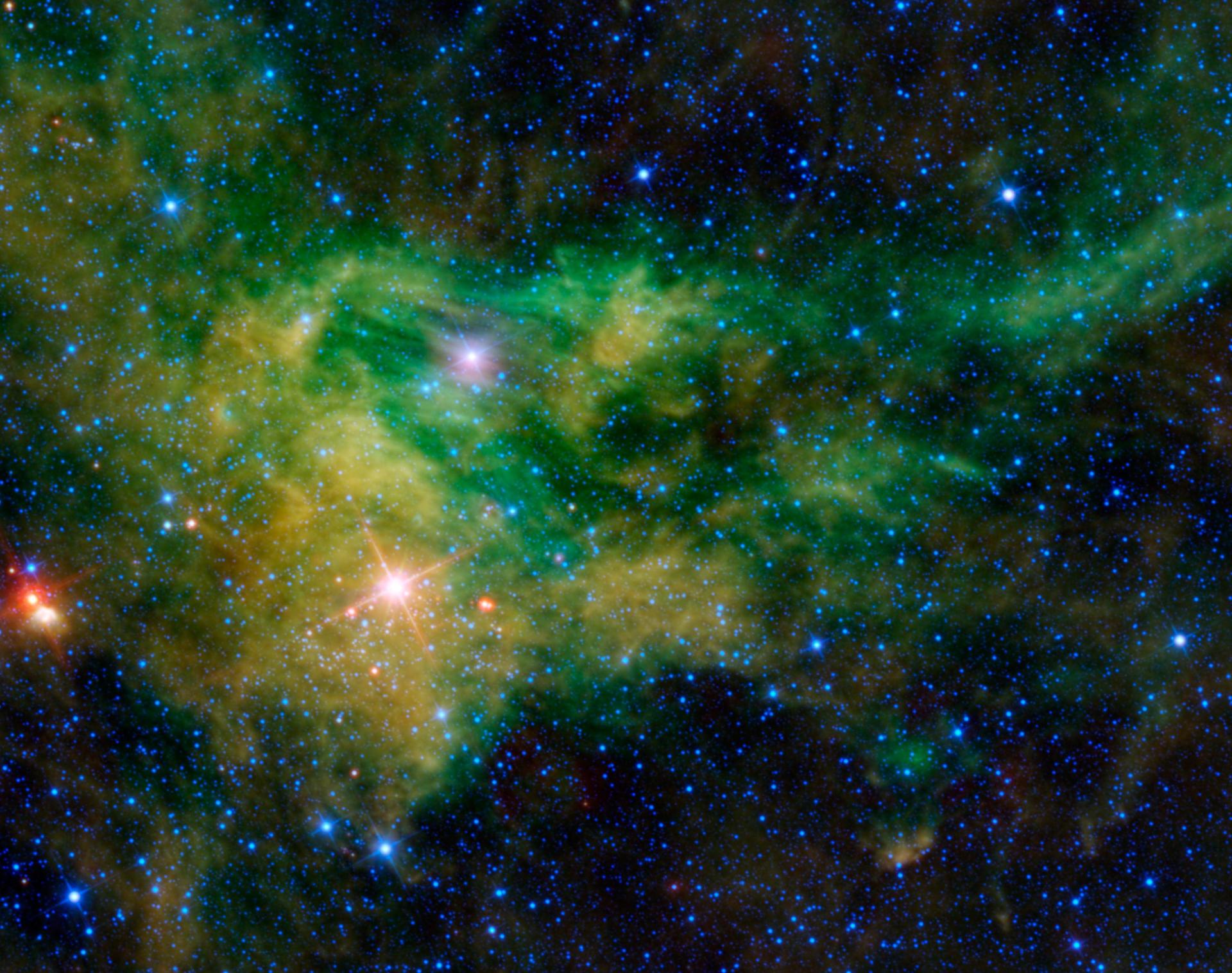
Fantastic Four Galaxies with Planet Artist Concept, credit: NASA/JPL-Caltech/Harvard-Smithsonian CfA, via NASA Image and Video Library
This week in science, 27 October – 2 November
The big science news this week, 27 October to 2 November, was a study linking even moderate drinking to cancer, heart disease and early death, a new estimate that global warming is speeding up, and a 17- to 18-million-year-old ape fossil from Egypt. Space brought an ISS spacewalk and a Vulcan target.
Some items are well supported; others are early findings or plans, and we say which is which. Nothing here is medical advice. For the previous week, see our 20–26 October roundup.
Space: spacewalks, launches and a telescope survey
A NASA and Canadian Space Agency spacewalk at the International Space Station installed the seventh roll-out solar array, with astronauts Menon and Kutryk outside for seven hours eleven minutes. Details here come from secondary reports rather than an agency release, so treat them with care. Another spacewalk is listed for 5 November at 8:10 am ET.
United Launch Alliance has targeted a mid-November return to flight for Vulcan, carrying 40 Amazon Project Kuiper satellites, after an investigation into a nozzle anomaly. That is a target only, not a confirmed launch date, and launch dates often slip.
SpaceX launched 27 Starlink V2 Mini satellites from Vandenberg, its 118th Falcon 9 mission of the year, and India launched the NVS-03 navigation satellite on a GSLV rocket. Turkey outlined a lunar programme with an orbiter slated for late 2027, a plan rather than a launch date. In science, Hubble and Webb studied 27 tiny, distant objects beyond Neptune, clues to the solar system's origins.
| Item | Detail | Status |
|---|---|---|
| ISS spacewalk | Seventh roll-out solar array installed | Reported done |
| Vulcan | Return to flight, 40 Kuiper satellites | Mid-November target |
| Falcon 9 | 27 Starlink V2 Mini from Vandenberg | Launched |
| GSLV | NVS-03 navigation satellite | Launched |
| Turkey lunar orbiter | Slated for late 2027 | Plan only |
| Hubble and Webb | 27 distant objects beyond Neptune | Studied |
Technology and AI: a satellite deal and a thin week for AI
The firmest technology story was commercial. Globalstar's share price rose more than 30% on 1 November after it disclosed that Apple plans to invest $1.5 billion in a new satellite constellation for iPhone communications. That is a plan and a market reaction, not a working network.
It was a thin week for AI. Several stories in search results could not be checked against a primary source, so we have left them out. For background on the technology behind many such claims, see what a large language model is.
Life and health: alcohol, tea and early warning signs
Is moderate drinking safe? A major study published this week links even moderate drinking to cancer, heart disease and premature death, and found no overall health benefit. Studies like this show associations, not proof of cause, and how to evaluate a claim explains why that distinction matters.
Other results are more cautious. A study of nearly 486,000 adults links regular tea drinking with an 11% lower risk of heart and blood vessel disease. A UCLA study links long-term exposure to a common pesticide with more than 2.5 times the risk of Parkinson's disease. Both are associations.
A major international study says a simple blood test could flag Alzheimer's-related decline years before symptoms: the highest-risk group had a 38% chance of impairment within five years and an estimated 78% within ten. A review found little reliable evidence that medical cannabis improves sleep. Researchers linked chronic lower back pain to a brain network, and University of Virginia scientists proposed a focused-ultrasound approach against glioblastoma, a proposal, not a treatment.
| Topic | Finding | Strength |
|---|---|---|
| Alcohol | Moderate drinking linked to cancer, heart disease, early death | Major study |
| Tea | 11% lower heart and vessel disease risk, 486,000 adults | Association |
| Alzheimer's blood test | 38% in five years, 78% in ten, top-risk group | Major study |
| Pesticide | Over 2.5 times Parkinson's risk | Association |
| Medical cannabis | Little reliable evidence for sleep | Review |
| Glioblastoma | Focused-ultrasound approach proposed | Proposal |
Is global warming speeding up?
A new study reports that global warming has reached about 0.35°C per decade since around 2015, nearly double the 1970–2015 average. The researchers say the acceleration holds at more than 98% statistical confidence after removing natural fluctuations. It is a single study. The wider picture of agreement is covered in our look at the climate consensus.
Scientists also proposed a link between the poles: cooling from Northern Hemisphere ice sheets may have reached Antarctic waters and disrupted Southern Ocean circulation, possibly helping to drive past ice ages. That is a proposal, not a settled finding.
Two smaller items: ancient ice in Tibet may be more than 128,000 years old, and crown-of-thorns starfish may help the Great Barrier Reef when their numbers are kept in check.

Fossils and physics
A 17- to 18-million-year-old ape fossil from Egypt is challenging ideas about where modern apes and humans first evolved. A single fossil rarely settles a question, but it can shift where researchers look next. Past errors show why care matters, as in the Piltdown hoax.
In physics, scientists built a molecular motor inspired by Archimedes' screw, which spins in either direction using electricity. A headline also reports that a 'forgotten' neutrino may help explain why matter survived the Big Bang. We have only seen the headline and summary, so treat that claim as untested.
What to look out for next
When is the Leonid meteor shower in 2026? It peaks on 17–18 November. It is modest, typically 10 to 15 meteors per hour from a dark site, but the Moon sets around midnight, leaving the pre-dawn hours dark. Other sights include Venus near Spica on 10 November, Mars and Jupiter within less than a degree on 15–16 November, and the Full Beaver Moon on 24 November.
The US midterm elections are on 3 November, and the Planetary Society holds a session on what the results mean for NASA on 4 November. The Secure World Foundation's 8th Summit for Space Sustainability runs 4–5 November in Brasília, the first held in Latin America and the Caribbean. NASA's MAX POWER expo at Kennedy Space Center has main events on 7–8 November. For why the sky looks as it does, see our explainer on Rayleigh scattering.
| Date | Event |
|---|---|
| 3 November | US midterm elections |
| 4 November | Planetary Society session on election results and NASA |
| 4–5 November | Space Sustainability Summit, Brasília |
| 5 November | ISS spacewalk, 8:10 am ET |
| 7–8 November | NASA MAX POWER main events |
| 10 November | Venus near Spica |
| 15–16 November | Mars and Jupiter close pass |
| 17–18 November | Leonid meteor shower peak |
| 24 November | Full Beaver Moon |

Try 20 UFO Sightings and What Really Happened
Searchlights over Los Angeles, Roswell’s balloon, radar ghosts, a lighthouse in a forest and the Navy’s Tic Tac: 20 true UFO stories and what investigators found.
Sources and further reading
Pages we opened when writing this article, last checked 2 November 2026. They open in a new tab, and we are not responsible for what other sites publish.
- ScienceDaily: Top Science News — Health, climate, fossil, physics and Hubble and Webb items.
- What's Happening in Space Policy November 1-8, 2026 — Elections, summit, spacewalk listing and MAX POWER dates.
- What's up in the night sky: November 2026 — Leonids, planets and Full Moon dates.
- This Week in Space, 1 November 2026 — Vulcan target, spacewalk, Starlink, GSLV and Turkey items (personal newsletter).
- SpaceNews news archive — Globalstar and Apple investment report (archive fragment).
This article was written with the help of AI. Before publication, automated checks confirmed that every listed source was opened and every picture is credited. Spotted a mistake? Write to [email protected].
More articles
This week in science, 20–26 October
Science news this week, 20–26 October: a 150-million-year-old bird fossil, Perseverance's driving record, a claimed exomoon and an AI-found PHP flaw.
This week in science, 13–19 October
Science news this week, 13–19 October 2026: the main space, AI, health, Earth and archaeology findings, explained with how strong the evidence is.

Climate Consensus: Where the 97 Percent Comes From
The famous 97 percent is not one poll. Here is what each major study counted, what critics said, and what the scientific record shows.