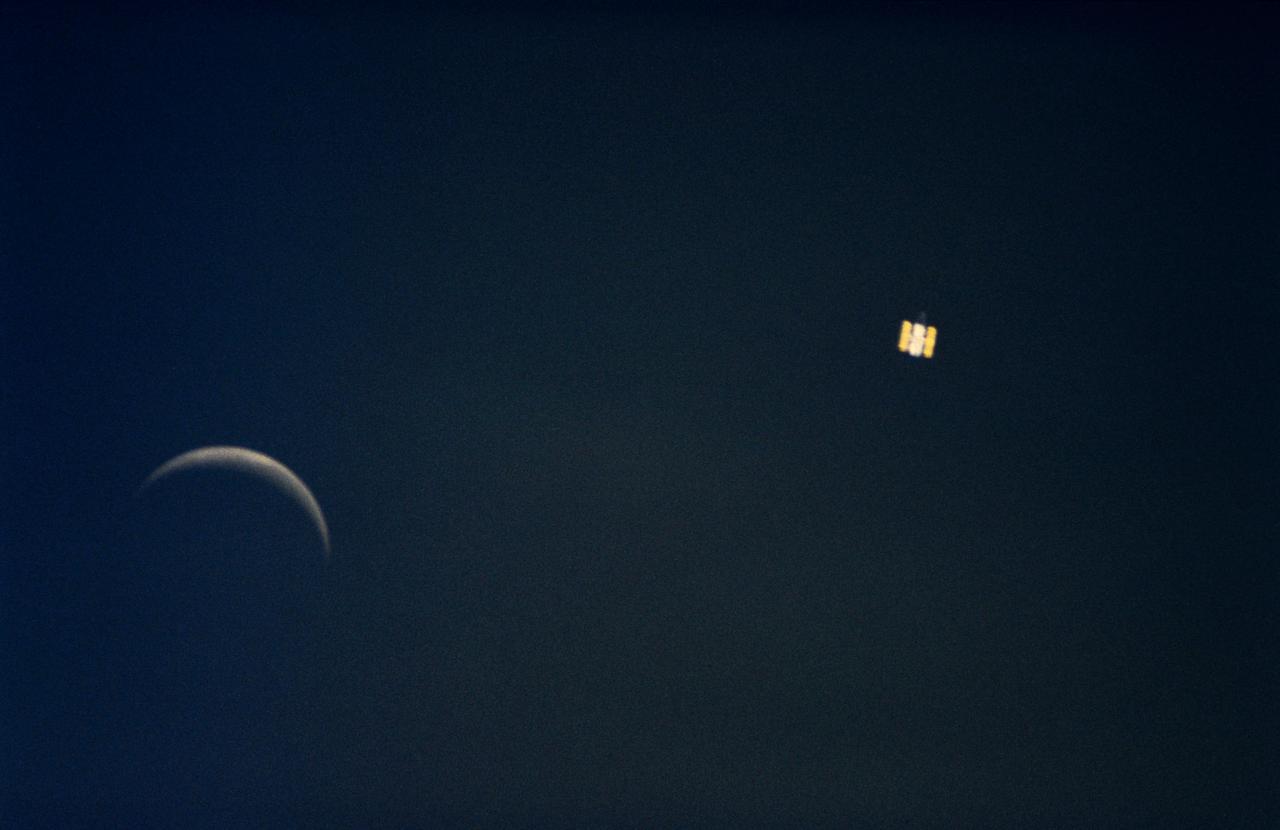
Onboard view from STS-61 of the Hubble Space Telescope and moon together, credit: NASA, via NASA Image and Video Library
This week in science, 3–9 November
The week's clearest science news is NASA's Swift telescope re-entering Earth's atmosphere on Wednesday, after nearly 22 years in space. New AI research posts and NASA's November skywatching calendar also stand out. This edition marks which claims are firmly sourced and which rest on summaries or press reports.
The window runs from 3 to 9 November, and each item below carries its own publication date within it. For last week's roundup, see our previous weekly edition.
What science news happened this week, 3–9 November?
Three stories are confirmed from the pages we opened: Swift's re-entry, AI research posts dated 4 to 6 November, and NASA JPL's November sky guide. Each is covered below with its date and how firm the evidence is.
Health, Earth, archaeology and physics headlines also appeared this week. We did not open the full studies behind them, so we do not report their findings as settled. Where a figure comes from a summary rather than a full study or primary post, the text says so.
| Story | Field | Date | Evidence level |
|---|---|---|---|
| Swift telescope re-entry | Space | Wednesday | Entry time confirmed by Space Force |
| Claude in science study | AI | 5 Nov | Index summary only |
| METR estimate on Anthropic | AI | 5 Nov | Roundup report |
| November skywatching guide | Astronomy | Published this week | NASA JPL sky guide |
What is the Swift telescope and why did it re-enter?
NASA's Neil Gehrels Swift Observatory re-entered Earth's atmosphere on Wednesday, ending a mission that lasted more than ten times longer than originally planned. The U.S. Space Force confirmed entry at 7:39 a.m. EST, above North Sumatra in Indonesia.
Swift launched in 2004 with three telescopes to study powerful explosions. It was built mainly to study gamma-ray bursts, and it also studied active galaxies, X-ray flares, supernovae, and comets and asteroids.
NASA expected most of the spacecraft to burn up but acknowledged that some components might survive the descent. The sources we opened do not say whether any pieces reached the ground.
| Fact | Detail |
|---|---|
| Launched | 2004 |
| Instruments | Three telescopes |
| Main purpose | Gamma-ray bursts |
| Re-entry time | 7:39 a.m. EST |
| Location | Above North Sumatra |
| Mission length | Over ten times planned |

What did the Anthropic study find about AI in science?
Anthropic's research index, dated 5 November, lists a study of how researchers use its Claude AI in science. The index summary reports 207,000 research sessions analysed. The index page does not contain the full findings, so that figure and any wider claims should be checked on the full study page before being relied on.
The index also lists a 4 November post on vault particles, which describes the first 3D structure of a vault particle found in prokaryotic cells, with Claude's role described. We have not seen the details of that work. For background, see our plain guide to large language models.
A weekly AI news roundup reports that the nonprofit METR estimated Anthropic's capabilities on well-defined benchmark tasks were improving at around 1.9 times the pre-October 2025 rate. METR stressed that the estimate is highly uncertain and that AI is not yet making major fully autonomous contributions to the most important stages of model training. We did not check METR's own post.
| Date | Item | Source type |
|---|---|---|
| 4 Nov | Vault particle post | Anthropic index |
| 5 Nov | Claude in science study | Anthropic index |
| 5 Nov | METR estimate, 1.9 times | Roundup report |
What else happened in AI and technology this week?
A weekly AI news roundup reports that OpenAI introduced GPT-6 Cyber, a model for authorised vulnerability research, restricted to approved defenders. OpenAI says it found 81 previously unknown high-severity Firefox vulnerabilities. Tencent released Hy4 on 4 November.
Moonshot AI published the weights for Kimi K3.1 Pro on 4 November, a model with 2.8 trillion total parameters and 104 billion active. Baidu launched Apollo World on 3 November, a simulation system for training robotaxis; the 100,000 km of simulated driving per day is Baidu's own estimate.
Google made Gemini Omni 1.2 Flash generally available for video generation on 5 November, with clips up to 15 seconds. OpenAI introduced Images 2.6 on 4 November, which the roundup says generates images 50% faster and adds native GIF creation. These are company claims, so treat the figures with care.
| Date | Company | Release |
|---|---|---|
| 3 Nov | Baidu | Apollo World |
| 4 Nov | Tencent | Hy4 |
| 4 Nov | Moonshot AI | Kimi K3.1 Pro weights |
| 4 Nov | OpenAI | Images 2.6 |
| 5 Nov | Gemini Omni 1.2 Flash | |
| Not dated in source | OpenAI | GPT-6 Cyber |
Health, Earth and archaeology: what is still unconfirmed
Several health, Earth, archaeology and physics headlines appeared on listing pages this week. The full studies were not opened, so this edition does not report their findings as settled. Early findings, especially in mice or from press summaries, often change.
Anyone looking for these stories should open the original study or the publisher's page before sharing them. Our guide to evaluating a claim offers a simple checklist.
When is the Leonid meteor shower and how do I see it?
NASA JPL gives the Leonid peak as 17 and 18 November, with up to about 15 meteors per hour under ideal conditions. Southern Taurids peak around 5 November, with possible bright fireballs. Northern Taurids peak around 12 November, at about five meteors per hour under ideal conditions.
Mars and Jupiter appear about 1.2 degrees apart on 15 and 16 November, in the southeastern sky before sunrise. NASA marks Voyager 1 reaching a distance of one light-day from Earth on 17 November, the first human-made object to do so. A full supermoon follows on 24 November, the first of three consecutive supermoons.
Rates are for ideal, dark conditions, so expect fewer meteors from a town. For why the sky looks as it does, see our explainer on sky colour.
| Date | Event | Detail |
|---|---|---|
| 5 Nov | Southern Taurids peak | Possible fireballs |
| 12 Nov | Northern Taurids peak | About 5 per hour |
| 15–16 Nov | Mars and Jupiter | 1.2 degrees apart, pre-dawn |
| 17 Nov | Voyager 1 light-day | First human-made object |
| 17–18 Nov | Leonids peak | Up to about 15 per hour |
| 24 Nov | Full supermoon | First of three |

Try 20 UFO Sightings and What Really Happened
Searchlights over Los Angeles, Roswell’s balloon, radar ghosts, a lighthouse in a forest and the Navy’s Tic Tac: 20 true UFO stories and what investigators found.
Sources and further reading
Pages we opened when writing this article, last checked 9 November 2026. They open in a new tab, and we are not responsible for what other sites publish.
- NASA's Swift telescope falls to Earth after nearly 22 years in space — Supports the Swift re-entry details, launch, instruments and Space Force timing.
- Anthropic Research — Supports the dated study listings, including 207,000 sessions and the vault particle post.
- Don't miss: Meteor showers, fireballs, and a supermoon light up November's night sky — Supports the meteor shower, planet, Voyager 1 and supermoon dates.
- AI News Of The Week (6th November, 2026) — Supports the METR estimate and the week's AI releases, as reported.
This article was written with the help of AI. Before publication, automated checks confirmed that every listed source was opened and every picture is credited. Spotted a mistake? Write to [email protected].
More articles
This week in science, 27 October – 2 November
Science news this week, 27 Oct to 2 Nov: alcohol and health studies, faster warming, an Egyptian ape fossil, a spacewalk and the November sky.
This week in science, 20–26 October
Science news this week, 20–26 October: a 150-million-year-old bird fossil, Perseverance's driving record, a claimed exomoon and an AI-found PHP flaw.

What Is a Large Language Model? A Plain Guide
The technology behind ChatGPT, Claude and Gemini, explained without jargon: how large language models are built, what they do well and where they go wrong.